The Ghost of the Typewriter: The Alice Layout Is Just a Mechanical Microsoft Natural
Dr. SigFor over a century, the "Ghost" of the mechanical typewriter has haunted our desks. The staggered physical layout was originally invented to prevent metal typebars from jamming—a mechanical constraint that hasn't existed for decades. Yet, this flaw was preserved by a powerful force: Microsoft.
In 1994, the Microsoft Natural Keyboard launched. It redefined "ergonomics" for the world, but it made a critical error: it curved the chassis but retained a misaligned staggered grid that prevents the wrists and fingers from staying in a neutral path.
Today, the "Alice" (or Arisu) layout is trending among enthusiasts. But let's look closer: it is essentially a mechanical version of the Microsoft Natural. It prioritizes commercial familiarity over anatomical truth.
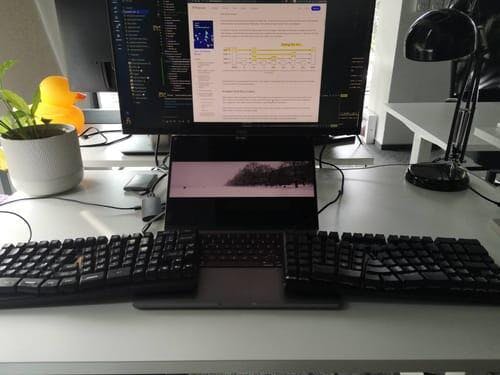
The Alice Layout is an aesthetic modification that keeps the flawed "staggered" columns of the 19th century. It improves wrist angle but forces fingers into a diagonal path. The X-Bows Radial Layout breaks the cycle by aligning keys into vertical columns that match the natural extension of the human finger.
Comparison Matrix: Alice vs. X-Bows
| Feature | Alice / Arisu Layout | X-Bows Radial Layout |
|---|---|---|
| Genealogy | ✗ 1994 Microsoft Natural | ✓ Biomechanical Research |
| Key Alignment | Staggered (Legacy Design) | Radial-Columnar (Anatomical) |
| Finger Path | Lateral (Side-to-Side Twisting) | Linear (Natural Extension) |
| Thumb Efficiency | Limited (Standard Spacebar) | ✓ Centralized Modifiers |
Why the Industry Clings to the "Stagger"
Why do designers stick to the staggered layout? Because it is easier to sell a "comfortable lie" than a "challenging truth." The Alice Layout creates an optical illusion of innovation. It looks futuristic, but it is built on the same skeletal structure as the legacy boards of the 90s.
The Biomechanical Reality: Your fingers do not grow diagonally. On an Alice/staggered keyboard, your fingers must make constant lateral micro-movements to find keys. This repetitive "zigzag" motion is a primary contributor to tendon fatigue and RSI. X-Bows arranges keys in Radial Columns—the first layout designed for the biology of the hand, not the mechanics of a typewriter.
Conclusion: Break the Legacy Cycle
Buying an Alice keyboard is often just buying a mechanical version of the same staggered problem. The X-Bows Knight represents the transition from the "Typewriter Era" to the "Biomechanical Era." It is a tool designed to adapt to you, rather than forcing you to adapt to the past.